This is the second in a series of posts that tell the story of one of the songs on my album, “In Case You Missed It. Today, I’m spotlighting “Better Than Anything.”
My first (and, for several decades, only) encounter with this song came from Al Jarreau’s 1977 album, “Look to the Rainbow,” a collection of live performance recordings from several European cities in 1976. At the time, I was swept away by a vocal style that sounded remarkably fresh and unusual to my – and I think others’ – ears. Many of you who know even a little about Jarreau will recognize what I’m talking about: part super scat and part, as we would probably call it now, beat box. It was pretty exciting and definitely the foundation of his musical brand.
At the start of his version of “Better Than Anything,” for example, as a vibraphone vamps in the background, he simulates a bass playing an introductory figure, sings the song’s title a few times and launches into the first verse. After a playful recitation of the verses, he slides into an extended vocal “drum” solo – without accompaniment – before coming back into the song, notably still on key.
Years later, even after my musical crush on Jarreau had gone away (his later music sounded a bit too, shall we say, engineered for wider, commercial airplay than I liked), his vocal gymnastics from his early years still excited me, though I would never even try to adopt them myself. You can hear them throughout this live album, including on “Take Five,” which might have been the first time someone put lyrics to that classic. On another recording there is also his vocal version of Chick Corea’s “Spain (I Can Recall),” which I highly recommend. I still consider Jarreau’s “Better Than Anything” to be better than anything anyone else did with the song, but that could be nostalgia talking. You tell me.
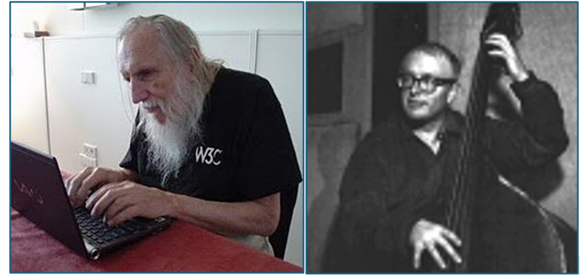
With lyrics by Bill Loughborough and music by David Wheat, pictured above from left to right (more about them below), “Better Than Anything” is a jazz waltz featuring a light listing of things that satisfy us and, in a couple of verses, stroll through some of the cultural landmarks of early 1960s America, when the song came into being. (The first released recording in 1963 featured Irene Kral with The Junior Mance Trio.)
One verse ticks off the jazz greats of the moment – most of them still alive then – including Dizzy Gillespie, Bill Evans, Miles Davis, Count Basie, Ella Fitzgerald and Billie Holiday. Another is a time capsule of many of the top TV shows of the time:
“Better than Lucy and Desi / Better than Route 66 / Better than Huntley and Brinkley / Better than quiz shows all fixed / Better than Kildare and Casey / Better than Singing with Mitch / Better than Hitchcock and Karloff / Better than clicking the switch / Better than movies late at night / Or watching Emile Griffith fight / Better than anything except being in love. ”
I’m just about old enough to know most of those references, even if I didn’t actually seem many. But the one about Emile Griffith sent me off to my good friend Mr. Google, who directed me to someone who explained that Griffith was a five-time world champion in three weight divisions. He is best known for a 1962 title fight in which he ferociously knocked out his opponent, Benny Paret III, who died 10 days later from his injuries in the ring.
The story goes that Paret had during the weigh-in taunted Griffith, who was gay (but not public about it at the time), with a homophobic slur. According to an account decades later:
“That night, rage and hurt poured out of Emile Griffith. It was a savage fight and, even though he was knocked down in the sixth round, Griffith dominated. Carnage broke out in round 12. It started with two brutal right hands from Griffith. Paret teetered backwards. He buckled sadly towards oblivion.
“In that moment, Griffith might have allowed the champion to fall. But he was about to punish Paret…. Griffith turned his body so that he could gain maximum torque with every punch he threw. Each one landed with deadening force. Paret’s head rocked on a neck that looked like a broken plinth.”
His was such an extraordinary story that it spawned an opera and a number of books and documentaries. And it was clearly big enough at the time that Loughborough and Wheat enshrined it (if only briefly) in this song.
Because “Better Than Anything” is a song of lists, many have taken the liberty of adding their own lyrics – kind of like an old folk song that has spawned dozens of verses. I’m not sure why, except that they may have been worried its references were a bit dated. (I kind of like that part.) Whatever the reason, this has become a thing.
In 1966, for instance, Bob Donough, recorded lyrics that many after him adopted:
“Better than cream cheese and bagels / Better than honey on bread / Better than champagne and pretzels / Better the breakfast in bed / Better than chili rellenos / Better than chocolate eclairs / Better than hothouse tomatoes / Better than fresh Barlett pears / Better than dining a la carte / Or sampling gastronomic art / Beter than anything except being in love.”
A number of artists used those same lyrics and added their own, such as when Natalie Cole asked Diana Krall during 2002 their rendition of the tune whether “love is even better than shopping?” To which Krall replies, “Well there’s a little sale at Barney’s I’m late for, but it’s still better.” I have the highest regard for both these women’s artistic talents, but, sorry, this makes me wince a bit. But who the hell am I? That single earned them a Grammy nomination.
And, to be fair, maybe I’m guilty of adding lyrics of questionable quality. When I perform the song, (though not on the recording), I usually add a verse that makes fun references to stuff in the news, introduces my band mates or whatever else rhymes. At a 2018 gig, I sang:
“Better than firing The Donald / Better than trying to resist / Better than feeding the tip jar / Better than songs made of lists”
Gotta get in that part about the tip jar while I fight the power.
I don’t have a time to listen to (nor are you likely interested in) all of the at least 58 covers of this song, but I do like what Nneena Freelon’s driving swing treatment of it in 2000, and this 1998 sleek vocal and guitar version by Tuck & Patti.
David “Buck” Wheat (March 19, 1922, to June 15, 1985), who wrote the music of “Better Than Anything” doubled as a folk and jazz musician. He spent some time in the late-‘50s and early ‘60s playing bass for the folk groups, Kingston Trio and the Whiskeyhill Singers. He also played jazz guitar with Chet Baker’s trio, along with other jazz groups.
Wheat and Bill Loughborough (1926 to 2010) were childhood friends who grew up in Texas. According to one account, Loughborough attended Georgia Military Academy from 1937 to 1942, and then, at age 16, he become one of the youngest ever to enroll in MIT. But he left MIT to become a musician in New York City, served in the Army and “San Antonio in 1949, where he managed a semi-professional baseball team, and umpired local baseball games; he moved to San Francisco in 1951, where he continued to work as an umpire.”
Loughborough later worked at University of California Medical Center as an electronics engineer, landing eventually at the Smith-Kettlewell Eye Research Institute in the 1970s, where, for about three decades, made many contributions to the world of vision science and rehabilitation.
Earlier, Loughborough and Wheat had teamed up to create an instrument called “Boo Bams” – tuned bongos made from hollow bamboo logs – that several jazz groups used in recordings and live performances.
In addition to “Better Than Anything,” Loughborough and Wheat also co-wrote CooCoo-U, an Afro-Cuban-style tune that emerged after witnessing Afro-Cuban performers. It appeared on the B-side of a 1959 Kingston Trio single, and Manhattan Transfer recorded it exactly 20 years later.
It’s a great and fun song that fits into the theme of my album: songs that aren’t obscure but aren’t as well-known as they ought to be. This one deserves a little more attention.
Thanks again to the guys who helped with my own recording of the song: Wayne Wilentz, piano; David Jernigan, bass; Leland Nakamura, drums; and Jeff Gruber, recording wizard.
Jeff
 Jeff Weintraub Music
You must be logged in to post a comment.